
Last Updated: March 22, 2026
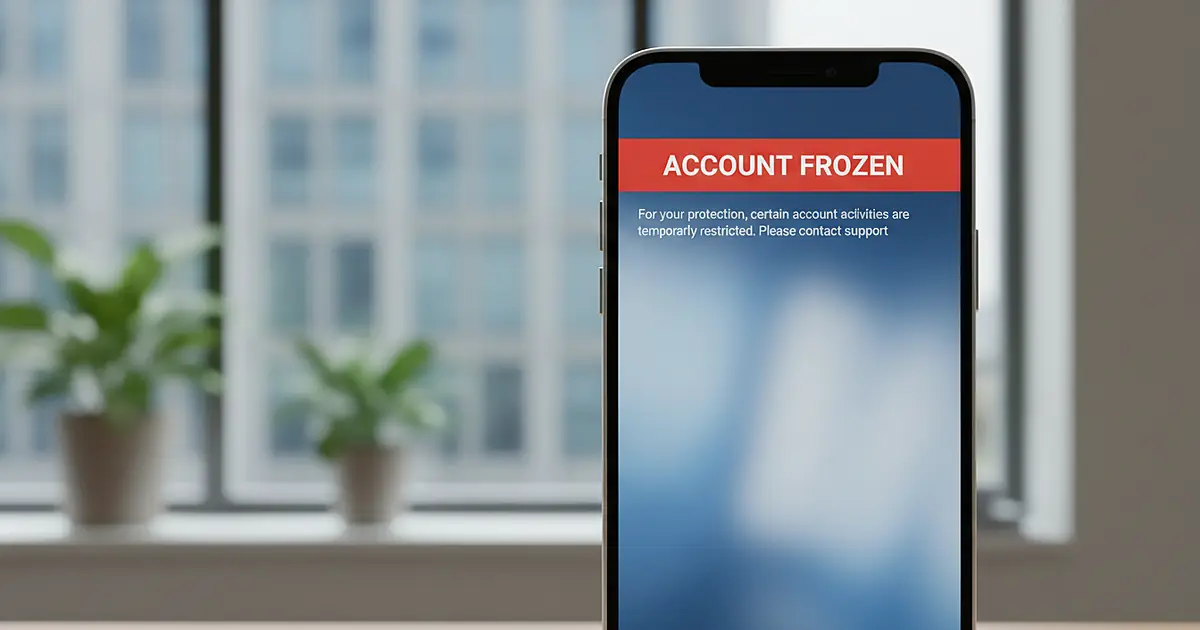
{ "title": "What to Do When Your Bank Freezes Your Account: A Guide to Consumer Rights and Resolution: Your Complete Guide (2026)", "content": "You’re standing in the checkout line with a cart full of groceries, or maybe you’re trying to send a quick Zelle to your landlord for rent. You swipe your card, and.. declined. You check your app, thinking maybe you just forgot about a subscription, but instead of a low balance, you see a message that makes your stomach drop: \"Account Restricted\" or \"Access Suspended.\" Your money is there, but you can’t touch it. It’s a financial nightmare that’s becoming more common as we move through 2026. Honestly, we've seen this happen way too often. We’re going to walk through exactly how to handle this mess and get your cash back.
\nNote: This article is for educational purposes only and is not financial advice. We recommend consulting a qualified financial advisor before making investment decisions.
\n\n\nWhat is What to Do When Your Bank Freezes Your Account: A Guide to Consumer Rights and Resolution?
\nThink of this guide as your emergency survival kit for when the banking system decides to put your life on pause. It isn't just a list of phone numbers. It’s a way to help you understand why institutions like Chase, Wells Fargo, or Bank of America suddenly pull the plug on your access and what legal levers you can pull to fix it. In early 2026, we’ve seen a massive spike in automated account freezes. This guide explains how federal law, bank policy, and your personal rights as a depositor work together.
\nAt its core, this process is about moving from a state of \"clueless victim\" to \"informed advocate.\" When a bank freezes your account, they often won't tell you why. They’ll cite \"security reasons\" or \"internal policy\" and leave you hanging. This guide helps you decode that corporate-speak.
\nFor instance, if you’re one of the thousands of people who saw their accounts flagged after the March 2026 NACHA rule updates, you need to know that your bank is likely using the new \"R17 (Risk Monitoring)\" return code. Knowing the technical terms helps you talk to the fraud department like someone who knows their rights. Which is the goal.
\nThis guide also covers the specific consumer protections that still exist in 2026. While banks have gained more \"Safe Harbor\" protections recently—meaning they can freeze accounts for longer without being sued—you still have rights under the Electronic Fund Transfer Act (Regulation E) and the Expedited Funds Availability Act (Regulation CC).
\nWe’re looking at the actual steps to file a dispute and escalate to a supervisor. If all else fails, you can bring in the heavy hitters like the Consumer Financial Protection Bureau (CFPB), which handled over 2.6 million complaints in 2025 alone.
\n\nHow does What to Do When Your Bank Freezes Your Account: A Guide to Consumer Rights and Resolution work?
\nThe resolution process works by hitting the three main reasons banks freeze accounts: suspicious activity, legal judgments, or regulatory compliance. Here’s the thing: your bank isn't necessarily trying to steal your money. They’re usually terrified of a federal fine. So what does this mean for you?
\nSince the new fraud monitoring rules went live on March 1, 2026, banks have turned up the sensitivity on their AI-driven surveillance. If you suddenly receive a $5,000 transfer from a friend when you usually only deal in $50 increments, the system triggers an automatic hold. Honestly, this is our favorite way to handle it: you provide \"Proof of Intent\" to satisfy those picky algorithms.
\nFirst, you have to identify the trigger. You call the bank and ask for the specific department handling the hold. Don't just talk to a general teller; you want the Fraud or Risk Management department. Say you’re a freelancer making $75,000 a year and you just deposited a large check from a new client.
\nThe bank might hold that for 7 to 15 business days under the 2026 \"Safe Harbor\" rules. We recommend providing the invoice and the client’s contact info immediately to shorten that window. You’re basically feeding the AI the context it lacks.
\nIf the freeze is due to a legal issue, like a debt collector getting a judgment, the process changes. In 2026, states like Illinois have protections (Public Act 103-0557) that automatically protect at least $5,000 in your account from being seized. The resolution guide helps you identify these exemptions so you can file a \"Motion to Vacate\" or a claim of exemption with the court.
\nIt’s a multi-step dance between you, the bank, and potentially a government agency. The goal is always the same: prove you are who you say you are and that the money is legitimate or legally protected.
\n\nIs What to Do When Your Bank Freezes Your Account: A Guide to Consumer Rights and Resolution worth it?
\nIs it worth the time and stress to fight a bank freeze? Absolutely. Sound familiar? If so, you know the alternative is letting your money sit in a black hole for weeks or even months. In 2026, the average time to resolve a \"suspicious activity\" freeze without active intervention is about 14 to 21 days.
\nIf you follow a plan, you can often get that down to 24 to 48 hours. Fast. In our experience, the \"cost\" of learning these rights is nothing compared to the fees you'll save. Think about it: a two-week freeze could lead to missed mortgage payments, $35 NSF fees on every bounced bill, and a hit to your credit score.
\nLet’s look at a real-world example. Imagine you have $12,000 in a Chase checking account. It’s your entire emergency fund and rent money. A freeze happens on the 1st of the month. If you wait for the bank to finish their \"investigation\" on their own timeline, you might rack up $200 in late fees and a week of high-stress phone calls from creditors.
\nBy using a resolution guide to immediately escalate the issue to the CFPB or a state regulator, you’re effectively forcing the bank to move your file to the top of the pile. In 2026, banks are required to respond to CFPB inquiries within 15 days, but they often move much faster once they see a formal regulatory complaint hit their dashboard.
\nBeyond the immediate cash access, it’s worth it for your long-term banking reputation. If a bank closes your account after a freeze, they might report you to ChexSystems. This is like a credit report but for bank accounts (and trust us, a bad mark there is a nightmare).
\nA negative mark there can make it nearly impossible to open an account at Ally, Capital One, or even a local credit union for five years. Resolving the freeze properly ensures your record stays clean, which is worth its weight in gold in a world where digital payments are mandatory for survival.
\n\nWhat are the pros and cons of What to Do When Your Bank Freezes Your Account: A Guide to Consumer Rights and Resolution?
\nThe biggest pro? Speed. You aren't guessing what to do; you have a checklist. You know that if the bank doesn't give you a clear answer within 48 hours, you move to step two: the formal written dispute. Another pro is the psychological shift. Being locked out of your money feels like a violation.
\nHaving a guide gives you some power back. You realize that while the bank has the \"Safe Harbor\" to freeze the account, they don't have the right to keep your money forever without cause. You’re playing offense instead of defense.
\nThe catch? The cons are mostly about the sheer effort required. Even with the best guide, you’re going to spend hours on hold. You might have to visit a physical branch with two forms of ID—which is a huge pain if you use an online-only bank like Varo or Chime.
\nAlso, the resolution process can sometimes backfire if you provide inconsistent information. If you tell one agent the money was a gift and another agent says it was for a car sale, the AI flags you for \"inconsistent narrative.\" Your freeze could turn into a permanent account closure. It requires precision and patience.
\nAnother downside is that some freezes are legally \"unfixable\" in the short term. If the IRS has placed a tax lien on your account or if there’s a valid court order for child support arrears, no amount of calling the fraud department will help.
\nThe resolution guide helps you identify these \"hard freezes\" early so you don't waste time. Bottom line: the pros of getting your money back fast far outweigh the cons of the bureaucratic legwork required to get there.
\n\nHow do I get started with What to Do When Your Bank Freezes Your Account: A Guide to Consumer Rights and Resolution?
\nGet started with immediate, documented action. The second you realize there’s a problem, open a notebook. Write down the date, the time, and exactly what happened (e.g., \"Tried to buy gas at 4:15 PM, card declined, app shows restriction\").
\nYour first call isn't to complain; it’s to gather intel. Ask three specific questions: Why is the account restricted? What specific department is handling the review? And what documentation do you need from me right now to lift this hold? Don't let them give you vague answers.
\nIf they say \"it's under review,\" ask for the expected completion date. Once you have the requirements, move fast. If they need a 1099, a bill of sale, or a copy of your passport, upload it through their secure portal immediately.
\nIn 2026, many banks like Wells Fargo use AI to scan these documents, so make sure the lighting is perfect and the text is clear. After you upload, call back. Confirm they received it. This \"active management\" of your case is what separates people who get their money back in two days from those who wait two months.
\nYou want your file to show constant activity from your end. If you hit a wall—meaning the bank won't talk to you or the freeze lasts more than three business days—it’s time to escalate. This is where you get started with the regulatory side.
\nHead to the CFPB website and file a formal complaint. Mention that the bank is \"withholding access to needed funds without providing a clear path to resolution.\" Also, check if your state has a Department of Financial Services. In 2026, state regulators are often faster than federal ones because they have smaller caseloads.
\n\nWhat are the risks of What to Do When Your Bank Freezes Your Account: A Guide to Consumer Rights and Resolution?
\nThe biggest risk isn't the resolution process itself; it’s the risk of doing it wrong. If you become abusive or aggressive with bank employees, they can (and will) note your account as \"hostile\" (and trust us, they'll close your account in a heartbeat). In 2026, banks have zero tolerance for this.
\nThis means they’ll close your account entirely and mail you a cashier's check for the balance. While that sounds okay, that check can take 7 to 14 days to arrive, and during that time, you are completely unbanked. You want to be the most polite, most persistent person they’ve ever talked to.
\nThere’s also the risk of \"Triggering a SAR.\" A Suspicious Activity Report is a secret document banks file with FinCEN when they think you’re up to no good. If your resolution attempt involves lying about where money came from or trying to \"structure\" deposits to avoid limits, you’re virtually guaranteeing a SAR filing.
\nOnce that happens, the freeze becomes much harder to lift because the bank is now legally prohibited from telling you they filed it. You’re essentially fighting a ghost. Honesty and transparency are your only real tools here.
\nFinally, there’s the risk of the \"Permanent Blacklist.\" If the freeze is resolved but the bank decides you’re \"too high risk\" to keep as a customer, they’ll close your account. This is happening more frequently in 2026 as banks tighten their risk models to save on compliance costs.
\nAlways aim for a resolution that leaves your ChexSystems report clean, even if you eventually decide to move your money to a different institution like SoFi or Vanguard.
\n\nSummary Comparison: 2025 vs. 2026 Banking
\n| Feature | \n2025 Standard | \n2026 Reality | \n
|---|---|---|
| Freeze Trigger | \nManual review or basic algorithms | \nReal-time AI behavioral profiling | \n
| Average Resolution Time | \n3–5 business days | \n7–14 business days (without intervention) | \n
| Bank Liability | \nModerate (fear of \"wrongful dishonor\") | \nLow (Safe Harbor immunity for fraud prevention) | \n
| CFPB Complaint Volume | \n~1.5 million annually | \n~2.6 million+ (projected) | \n
| ACH Return Codes | \nStandard R01, R03 | \nEnhanced \"R17 (Risk Monitoring)\" for holds | \n
Look, I know this is a lot to take in. Discovering that your own money is being held hostage by a billion-dollar corporation is enough to make anyone want to scream. But here’s the bottom line: the banking system in 2026 is built on \"safety first, customers second.\"
\nThey would rather freeze 100 innocent accounts than let one fraudulent transaction go through. It isn't personal, even though it feels that way when you can't buy dinner. Your best defense is a good offense. Don't keep all your eggs in one basket.
\nIf you're making $65,000 a year, split your direct deposit—maybe $3,000 goes to your main Chase account and $1,000 goes to a high-yield savings account at Ally. This way, a single \"glitch\" or AI-flag doesn't paralyze your entire life.
\nIf you do get frozen, stay calm, document everything, and don't be afraid to escalate. You have rights, you have a voice, and with the right steps, you’ll get your money back. Just remember to keep that notebook handy and keep pushing until that \"Restricted\" status disappears for good.
", "excerpt": "Locked out of your cash? Our 2026 guide breaks down why banks like Chase and Wells Fargo freeze accounts, your legal rights, and the exact steps to get your money back fast.", "takeaways": [ "Identify the trigger by calling the bank's fraud department immediately.", "Document every interaction, including agent names and case reference numbers, to build a trail for escalation.", "File a CFPB or state regulatory complaint if the freeze lasts more than 48 hours without a clear resolution path.", "Maintain a backup account to ensure access to your money during a primary account freeze." ], "tags": [ "Bank Account Freeze", "Consumer Rights", "Personal Finance 2026", "CFPB Complaints", "Banking Regulations" ], "sources": [ { "name": "Consumer Financial Protection Bureau (CFPB)", "url": "https://www.consumerfinance.gov/" }, { "name": "Nacha Operating Rules 2026", "url": "https://www.nacha.org/" }, { "name": "FDIC Consumer Protection", "url": "https://www.fdic.gov/consumers/" } ] }


